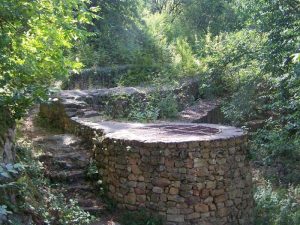
Bozhenishki Urvich Fortress is located on the northern slopes of Lakavishki Hill, 3 km from the village of Bozhenitsa and 20 km from Botevgrad at 750 m above sea level. An asphalt road leading to the foot of the fortress will take you to Urvich municipal resort house. From there you can reach the fortress hiking on a marked path for about 20 minutes. The secrets of this old fortress began to come to life in 1918 when after a storm in the roots of a fallen ancient tree there was discovered a medieval rock inscription.
Academician Petar Mutafchiev was the first to read and interpret the Bozhenitsa inscription. He notes that the „cutter“ of the inscription „did not take care to pre-measure the slab stone on which he worked. He started with large letters, but seeing that the space he had would not be enough for it, he reduced the size of the letters and increased, where possible, the length of the lines. He read the inscription as follows: „I, Sevast Ognyan, was with Tsar (meaning king) Shishman Kefalia and suffered a lot of evil. At that time the Turks were at war. I supported the faith of Shishman, the Tsar.“
Scholars are unanimous: „With its uniqueness, both with its historical and philological significance, the Bozhenitsa inscription of Sevast Ognyan enriches „the stone archive“ of medieval Bulgaria.“
According to the archaeological excavations conducted in 1972, the place was inhabited in prehistoric times, but the first fortifications date from the 6 -7th century as a unit of the early Byzantine defence system. Bozhenishki Urvich fortress flourished in the 13-14th century when the outermost fortress wall was built, blocking from the north the only accessible place from the village of Bozhenitsa.
At the end of the 14th century, it was the seat of the Boyar Ognen (Ognyan) – a mullet under Tsar Ivan Shishman. It is impressive with its 10 m deep water cistern, as well as the chapel carved into the rock inside the fortress. A treasure of silver coins from the time of Ivan Shishman was found near the gate, at a depth of 0.2-1.5 m. Hundreds of arrowheads and spears, stone battle balls and skeletons of warriors found near the fortress walls confirm the legend of the battle of Sevast Ognyan with the Turks (1395).
Status: Since 1966, it has been an ancient, medieval fortress is of national importance.